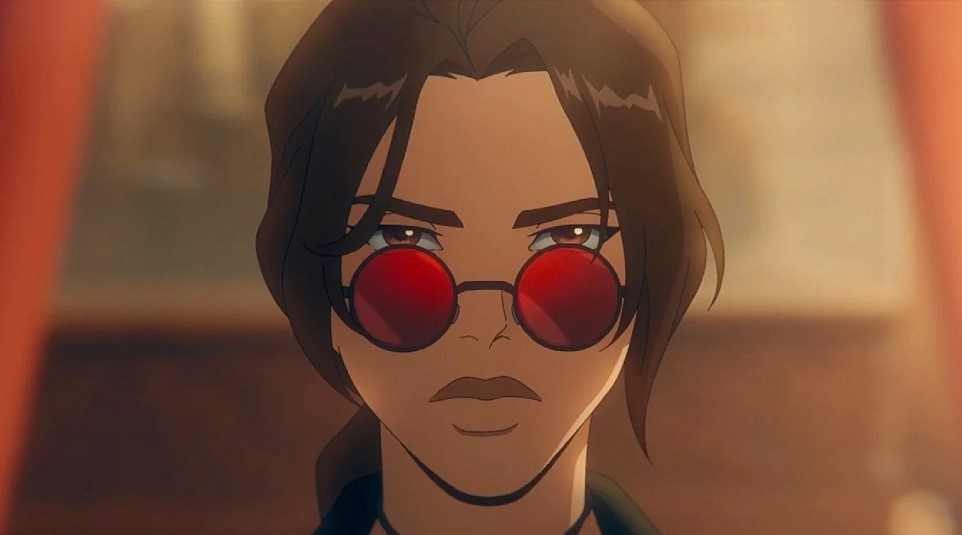
The second season of Netflix’s animated series about Lara Croft once again follows a familiar formula: ancient artifacts, a global threat, and travels to various corners of the world. Only this time, the “familiar” too quickly becomes “deregistered.” Especially as Netflix once again attempts to tell an unrelated story, hiding behind an iconic character and, with astonishing persistence, making the same mistakes over and over again.
Familiar pitfalls, new route
The second season of The Legend of Lara Croft begins shortly after the first season’s finale and formally continues the storyline established after the Survivor trilogy. Structurally, it’s a direct sequel, but the very first episodes create a sense of déjà vu. The story once again revolves around ancient artifacts with limitless power and an influential benefactor who offers Lara help for a “higher purpose.”
The focus is on the organization Pithos and its head, Mila, a billionaire who preaches the ideas of “ethical archaeology” and the “green agenda”—in short, all the “good things” that save the world and all that other “blah-blah-blah.” Under the plausible pretext of returning stolen relics to their rightful owners, she offers Lara resources to find ritual Orisha masks from Yoruba mythology, which supposedly need to be returned to Benin.
By a convenient coincidence, one of these masks is discovered in Lara Croft’s father’s collection. The artifact is formally donated to a museum, but this doesn’t stop the heroine. Lara steals it, eager to quickly deliver the relic to Mila and thereby “correct” the mistakes of the past. It soon becomes clear that these good intentions were merely a cover, and Lara herself has once again become a convenient tool in someone else’s game.
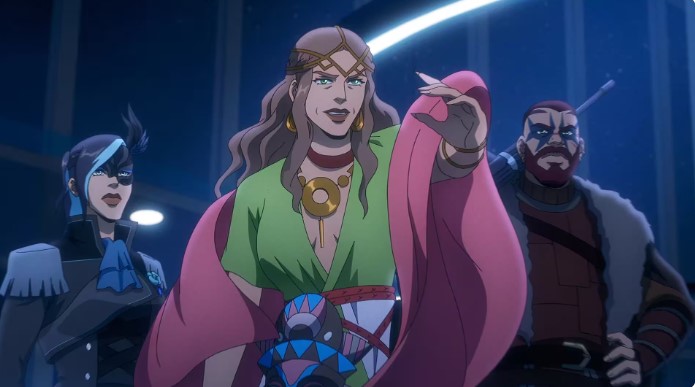
Having received the mask, Mila sheds her guise as a benefactor—literally and figuratively. She reveals her plan and declares her goal to collect all the Orisha masks in order to reshape the world according to her vision. Already at the end of the first episode, Mila dons the mask of Oko, the deity of fertility, gains the power to control the earth, and without hesitation destroys an entire village, along with the artifact’s former owner.
The story once again revolves around a global race for artifacts. Lara and her allies travel across the globe, trying to stop the impending catastrophe.
The problem is that this setup is all too familiar. And it’s not just the straightforward “Infinity Mask”-collecting structure, which almost mirrors the first season’s. To cite examples from projects familiar to gamers, the villain once again justifies her actions with a “green agenda,” as she did in Splinter Cell: Deathwatch, and the conflict itself is once again framed through the prism of neocolonialism, echoing themes from Castlevania: Nocturne.
Netflix’s closets have been filled with such skeletons for years, but sometimes coherent and engaging stories emerge from this plethora of themes. However, that’s not the case here.
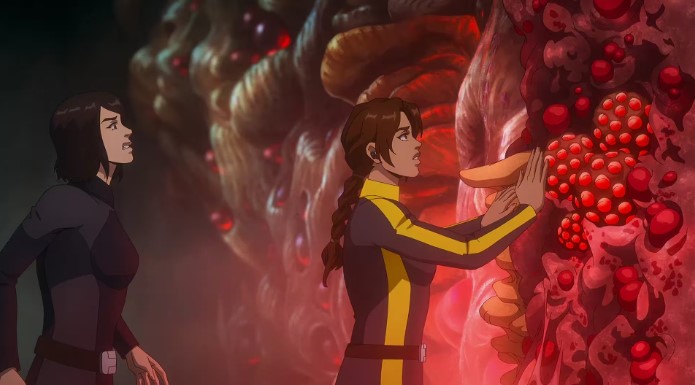
The Legend of Eshu
The main problem with the second season is its lazy script. It’s already been said that it largely repeats the first, but in practice, it’s even worse. The writers even manage to ruin the controversial formula that held the series together previously.
The first season revolved around guilt, trauma, and the struggle to understand the consequences of both others’ and one’s own decisions. The second logically needed to capture the outcome of this journey and show Lara as a more experienced and cautious person.
Instead, she once again trusts the first person she meets implicitly. Not because it’s her character or her internal conflict, but because it’s the most convenient way to move the plot forward. At some point, it begins to seem like screenwriter Tasha Huo simply can’t do it any other way. A familiarity with her previous work, even if only through professional references, only reinforces this feeling.
The charismatic antagonist of the first season, who only truly descended into charades towards the finale, is replaced by a character who doesn’t even try to be interesting. From the first frame to the last, he’s a cliched “savior of the world” with a god complex, zero depth, and a complete lack of charm. His motivation is conveyed by a couple of generic lines that contradict the action onscreen and are never further developed.
There’s no internal conflict, no evolution, no attempt to make the antagonist a living person, not a scripted function. The imitations of the Marvel Cinematic Universe’s Thanos repeatedly miss the point: he was memorable not for his scale or the box office success of the Avengers films, but for his clear motivation and a coherent character that, at a certain point, was worthy of empathy. Season two of The Legend of Lara Croft delivers nothing of the sort.
It’s equally frustrating that Lara herself stagnates in her development. After the emotional torment of the first season, her personality seems to be ingrained in the second. Croft emerges as a confident and seasoned adventurer, closer to her classic image and free of her former fears. But that’s where the progress ends. No new internal conflicts emerge, and her character doesn’t become more complex. It’s as if the writers decided that Lara has already fulfilled her quota of “character growth.” As a result, she jumps, fights, and shoots, but as a character, she doesn’t change.
This is understandable, given that the second season consistently transforms Lara into an observer of others’ fates rather than the driving force of the story. Although she encounters various Orisha mask-wearers throughout the narrative, a key role among them is given to Ash, also known as Papa Legba—a trickster and conduit between the worlds of the living and the dead in the voodoo tradition.
As befits a trickster, Eshu is chaotic, erratic, and full of hidden pain. The series quickly focuses on him, offering a vibrant character with a clearly defined internal drama: Eshu is tormented by guilt for leaving his people defenseless at a critical moment, abandoning his power and responsibility. This guilt becomes the primary driver of his actions and forms a full-fledged story arc that develops from episode to episode.
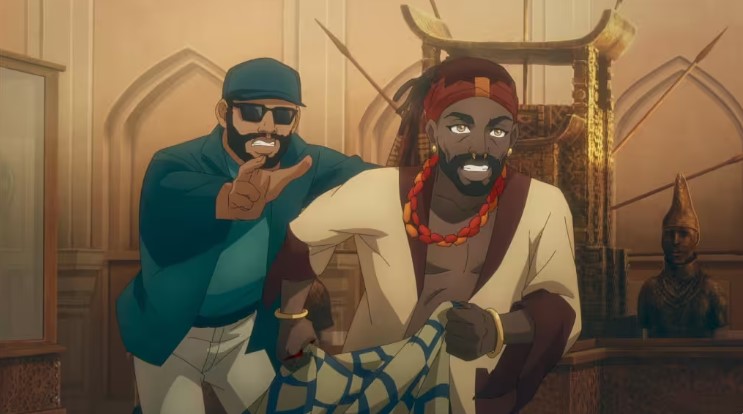
Ultimately, the series unexpectedly devolves into “The Legend of Ash,” with Lara relegated to the role of facilitator on another hero’s journey of transformation. Of course, Ash himself is a success—it’s hard to make such unpredictable tricksters uninteresting, and here he truly lifts the sagging plot. However, Lara Croft fans may be offended by the fact that in the second half of the season, the titular tomb raider ends up as a mere bystander to someone else’s mythological showdown.
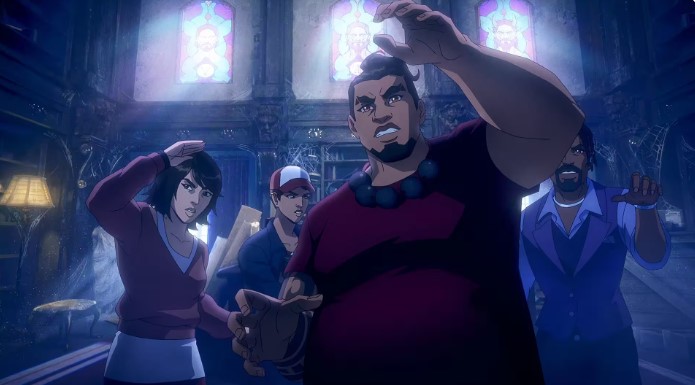
Lara’s team, seemingly reunited after the events of the first season, is relegated even further to the narrative periphery. These characters serve a largely declarative function—showing that Lara has learned to accept help and work as a team—but this doesn’t develop dramatically or have any consequences.
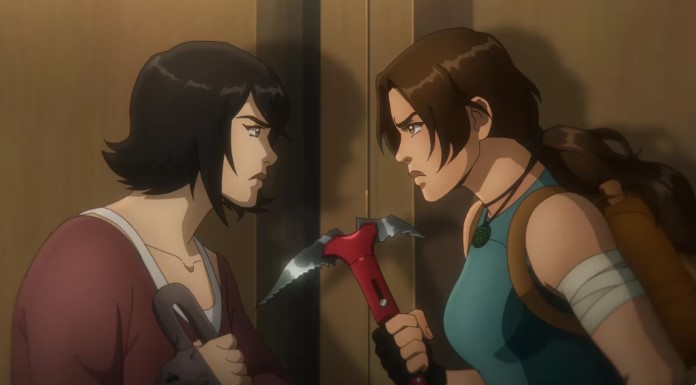
Sam, in this context, emerges slightly more prominent than the others. She gets more screen time and formally becomes a significant player in the events. However, the dynamic between Sam and Lara is only sketched out and never extends beyond a functional partnership. In terms of their influence on the events, they are almost equal and primarily react to the conflict already underway. This only emphasizes Lara’s secondary role in her own story.
Tomb Raider Unlimited
Visually, Powerhouse Animation offers no surprises. It’s the same solid craftsmanship, with no revelations or glaring failures, virtually identical to the first season and the studio’s other projects. Expressive characters, fluid facial expressions, and precise choreography are combined with modest detail and extensive use of 3D backgrounds, which help conserve resources without sacrificing scale.
Ultimately, the series feels like a typical Netflix production—functional, stable, but at times sterile and lacking in personality.
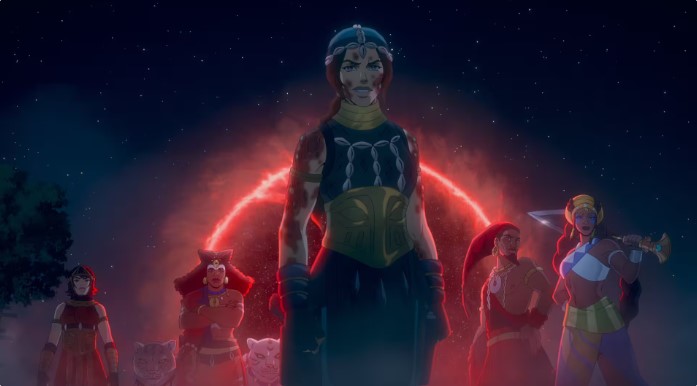
However, when comparing the action with the first season, the contrast is stark. In the second season, fight scenes are either brief or secondary in importance. When the plot reaches clashes involving divine powers and the magical capabilities of the Orisha masks, Lara simply has no way to counter characters on a different level of the power hierarchy.
Even in the season finale, where the series explicitly references Avengers: Endgame, Lara remains on the periphery of the action. In the climactic scene, the titular heroine simply doesn’t have a full place. Spells are cast, portals open, and characters with divine powers clash in spectacular duels, while Lara is once again confined to a local duel that has no impact on the outcome of the conflict.
Against this backdrop, the first season unexpectedly emerges as a winner. The opening episodes already offered a dense action sequence with chases, traps, a fight with an alligator, and a series of dynamic fights that surpassed most of the second season in variety and pace.
Beyond the “routine” action, there were plenty of truly memorable scenes—a motorcycle chase through a crumbling city, a fight with a Tyrannosaurus, and an infiltration of a mansion where Lara, under the influence of a relic, brutally and skillfully dispatches the guards.
After watching the second season, I felt like there was noticeably more action before, and rewatching the first season confirmed this. The difference was colossal. Moreover, the action didn’t just fill the running time; it worked to enhance Lara’s image as a tomb raider—a heroine constantly confronted with traps, riddles, and mortal danger.
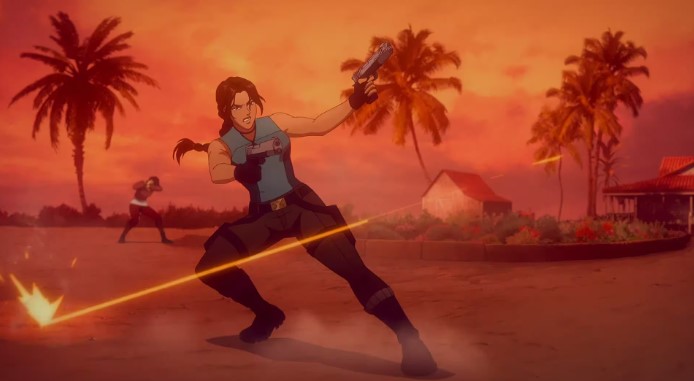
In the second season, this is almost entirely gone. The locations appear poorer and more repetitive, tombs, temples, and trials disappear entirely, and the geography of travel loses its expressiveness. Changes in countries aren’t always visually noticeable. The choreography is simplified, the color palette is duller, making the visuals themselves seem less vibrant. Instead of mythologically-based puzzles and active interaction with the environment, Lara increasingly finds herself in standard combat sequences without inventive staging.
As a result, the second season doesn’t just offer less action. It loses the very essence of Tomb Raider’s adventure, turning the action into a backdrop to someone else’s story. This is precisely why it’s hard not to revisit the first season and give it more praise than it did a year ago. Overall, aside from the spectacular death of the antagonist, direct references to the games, and isolated references—like the elevator scene with its obvious nod to Evangelion—the second season is largely unremarkable.
In this scenario, the first season doesn’t look like a masterpiece, but it’s a full-fledged and relevant entry in the Tomb Raider franchise. A year ago, it at least seemed like a solid middling film, worth watching for the action. Today, the second season can’t even justify its own existence.
Diagnosis
The second season of “Tomb Raider: The Legend of Lara Croft” formally corrects some of the mistakes of the first. Lara is no longer stuck in endless self-analysis, acts more confidently, once again wields her iconic pistols, and works as part of a team. She’s no longer the traumatized survivor of the post-Survivor era, but a seasoned adventurer, noticeably closer to her classic image. It would seem that this is the moment the series should have finally blossomed into its full potential.
However, along with its downsides, the second season also abandons its strengths. The plot quickly ceases to be a Lara Croft story and turns into yet another mythological drama with new characters, where the titular heroine is relegated to a supporting role.
Taken separately from the franchise, it could be considered a watchable mid-level animated product—crafted, polished, and designed to fill a catalog, without revelations, but also without disasters. As a sequel and a Tomb Raider installment, however, it feels like a disappointment. The action is impoverished, the adventure element is almost nonexistent, and the antagonist remains flat from the start. The second season fails to develop the ideas established earlier and consistently abandons everything that made the series’ existence even remotely worthwhile.
It was previously reported that this season would be the last, as Netflix had only commissioned two. After watching, you realize that if there isn’t a third season, so be it. Lara Croft herself, as a character and as a franchise, isn’t going anywhere and, by all appearances, will be with us for a long time to come.
The legend lives on, but replaying it on Netflix is like chewing old gum, which loses its flavor faster and faster with every movement of the jaw.